Grand Canyon KOA Holiday - South Rim Trip Planning Guide
First Time at the Grand Canyon: Everything You Need to Know Before You Go
Seeing the Grand Canyon for the first time is one of those travel moments that is hard to describe until you are standing at the rim. It is also a trip that can feel surprisingly complicated when you start planning. Where should you enter? Where do you park? Do you need a shuttle? Which viewpoint should you see first? How early should you arrive? How much walking is involved? And how much time do you actually need?
The good news is that your first Grand Canyon trip does not need to be complicated. If you are staying at Grand Canyon KOA Holiday, think of us as your place to recharge before and after the big adventure. You can spend the day exploring the South Rim, then return to a quieter home base where tomorrow does not have to start with packing your entire trip into the car again.
Here is what first-time visitors should know.
The South Rim Is Open Year-Round
The South Rim of Grand Canyon National Park is open 24 hours a day, 365 days a year. Visitor services, road conditions and shuttle schedules can change by season, so always check current National Park Service alerts before leaving for the day. Winter visitors should be especially aware of snow and icy roads. Summer visitors should plan around larger crowds and possible afternoon thunderstorms.
How Far Is Grand Canyon KOA Holiday From the South Rim?
Grand Canyon KOA Holiday is located in the Williams area and is roughly a 45-minute drive from the South Rim, depending on traffic, road conditions and where you are headed inside the park. That makes it easy to get an early start while still staying outside the busiest park areas.
Where Should First-Time Visitors Start?
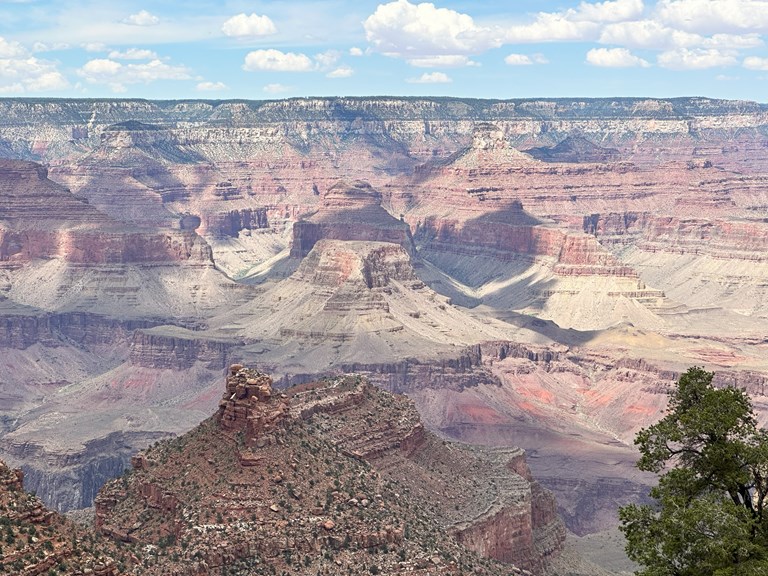
For many first-time visitors, the Grand Canyon Visitor Center area is the easiest place to begin. From there, you can walk to Mather Point for your first major canyon view. Mather Point is popular for a reason. The view is enormous, the overlook is easy to reach and it gives you an immediate sense of the scale of the canyon. From Mather Point, you can continue about 0.7 miles along the rim toward Yavapai Point and the Yavapai Geology Museum. That simple walk is one of our favorite introductions to the South Rim.
What Time Should You Arrive?
Earlier is usually better.
During busy seasons, parking near the Visitor Center can fill later in the morning and shuttle lines may become
longer.
An early start can give you:
• Easier parking
• Cooler temperatures
• Smaller crowds
• More flexibility
• More time to explore without rushing
If you are visiting for sunrise, plan to arrive well before the sun reaches the horizon.
Do You Need to Use the Shuttle?
You do not have to use the shuttle for every part of your visit, but the free South Rim shuttle system can make
your day much easier. Routes connect the Visitor Center, Grand Canyon Village, trailheads and scenic overlooks. The exact routes and schedules change by season. From spring through fall, Hermit Road is generally closed to private vehicles and accessed by shuttle, commercial tour, foot or bicycle. Before your visit, check the current shuttle map rather than relying on an old screenshot.
Do You Need to See Every Viewpoint?
No.
This may be the most important piece of advice for first-time visitors.
The Grand Canyon is not a checklist.
You do not need to stop at every overlook.
For a first visit, choose a few experiences and enjoy them.
A great simple day could include:
• Mather Point
• Yavapai Point
• Grand Canyon Village
• A section of the Rim Trail
• One or two Hermit Road viewpoints
• Sunset if everyone still has energy
That is already a full and memorable Grand Canyon day.
What Should You Bring?
For a typical South Rim sightseeing day, bring:
• Refillable water bottle
• Comfortable walking shoes
• Sunscreen
• Sunglasses
• Hat
• Layers
• Weather-appropriate jacket
• Snacks
• Small backpack
• Portable phone charger
• Camera or phone
The South Rim sits at roughly 7,000 feet in elevation.
Do not pack for the Grand Canyon based only on what you think Arizona weather should feel like.
How Much Walking Is Involved?
That is completely up to you. You can experience major views with relatively short walks, or you can spend hours walking the Rim Trail. One of the easiest first-time strategies is to combine walking and shuttles. Walk until you are ready for a break. Ride to another area. Explore again. There is no requirement to hike below the rim to say you experienced the Grand Canyon.
Should You Hike Below the Rim on Your First Visit?
Maybe - but do not make the decision casually. Grand Canyon hiking is different because you go downhill first and climb back out at the end. Temperatures also become warmer as you descend. If you are planning a below-the-rim hike, research the trail in advance, understand the elevation change, check current conditions and carry appropriate water and supplies. For many first-time visitors, a Rim Trail day is more than enough.
Where Should You Eat?
Food is available in several South Rim areas, but bringing snacks or a simple lunch can make your day more
flexible. Do not let lunch turn into an hour of searching for food when everyone is already hungry. If you are traveling with kids, bring more snacks than you think you need.
Should You Stay for Sunset?
If everyone still has energy, sunset can be one of the best ways to end a Grand Canyon day. Hopi Point is famous, but it can also be busy. Mohave and Pima Points can offer excellent views with the Colorado River visible below. Desert View and Lipan Point are also strong choices if they fit your route. Arrive early enough to settle in, and bring another layer for the temperature drop after sunset.
What About Sunrise?
Sunrise often means fewer people and clearer morning air.
Mather Point and Yaki Point are popular sunrise locations.
The tradeoff is simple:
You have to get up early.
If you are staying at Grand Canyon KOA Holiday, prepare the night before so your morning is easy.
Fill water bottles.
Set out layers.
Charge your phone.
Know where you are going.
Then get some sleep.
How Long Should You Spend at the Grand Canyon?
For most first-time visitors, one full day can provide an excellent introduction. Two days gives you more freedom. You can explore the main Visitor Center and Village areas on one day, then use another day for Desert View, additional overlooks, a longer Rim Trail walk or a sunrise/sunset experience. If you have traveled a long distance to get here, do not be afraid to stay several nights.
What Should You Do After the Grand Canyon?
Go back to camp.
Seriously.
You do not need another attraction immediately after a full Grand Canyon day.
Return to Grand Canyon KOA Holiday.
Eat.
Sit outside.
Talk about what everyone saw.
Look at the stars.
Get a good night's sleep.
Then decide what tomorrow looks like.
Maybe it is another Grand Canyon day.
Maybe it is Williams and Route 66.
Maybe it is Bearizona.
Maybe it is nothing.
Why Stay Outside the Park?
Staying outside Grand Canyon National Park can give you more separation between your sightseeing day and
your downtime. At Grand Canyon KOA Holiday, you can use the campground as a base instead of making the entire vacation feel like one long day inside the park. For RV travelers, that may mean leaving the rig set up while you explore. For cabin guests, it means having a home base to return to. And for everyone, it means you do not have to pack and move every morning.
Your First Grand Canyon Trip Does Not Need to Be Perfect
You will not see everything.
That is okay.
See the canyon.
Walk the rim.
Take the picture.
Then put the phone down.
Ask a ranger a question.
Sit for a minute.
Watch the light change.
The best Grand Canyon trip is not the one with the longest itinerary. It is the one where you actually had time to experience the place. Make Grand Canyon KOA Holiday your basecamp, get an early start and give yourself permission to slow down. The Grand Canyon is the adventure. We help make the rest of the trip easier.